

 English
 русский
 Français
 Español
 عربى
In a Permanent Magnet Variable Frequency Generator, the engine no longer has to hold one speed to hold one frequency. A conventional alternator ties the two together through f = P × N ÷ 120, where P is the number of poles and N is the speed in revolutions per minute. A two-pole machine must turn at 3,000 rpm to give 50 Hz and 3,600 rpm to give 60 Hz, and a four-pole machine needs 1,500 or 1,800 rpm. Let a four-pole engine slip to 1,750 rpm under a heavy load and the frequency falls to 58.3 Hz, which is why such sets run at full speed whatever is plugged in.
What the Magnets Change
A permanent magnet rotor produces its own field, so it needs no excitation current and no brushes or slip rings, and it avoids the loss that comes from magnetising a wound rotor. The trade-off is that the field cannot be adjusted. With a fixed magnet field, the terminal voltage rises in direct proportion to speed, and frequency rises with speed as well.
The raw output of a Permanent Magnet Variable Frequency Generator is therefore neither a steady voltage nor a steady frequency. It is an alternating supply whose size and pitch follow the engine, and it needs a conversion stage before any appliance can use it.
Rectify, Then Rebuild the Wave
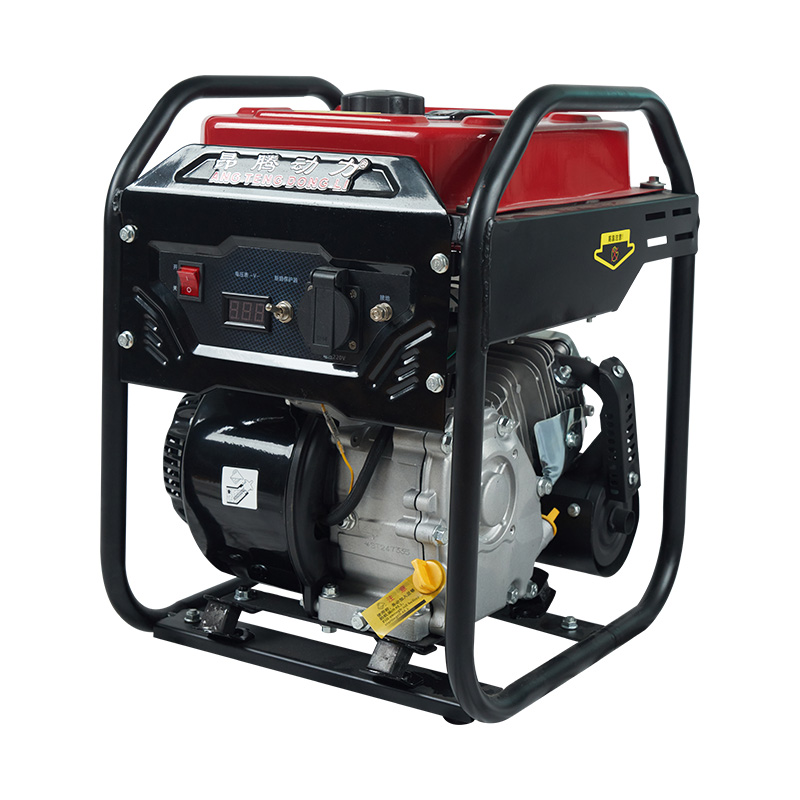
The conversion stage of a Permanent Magnet Variable Frequency Generator does two jobs in sequence. A rectifier turns the variable AC into direct current, and an inverter builds a new alternating wave from that direct current at the voltage and frequency the load expects, either 50 Hz or 60 Hz. This is the arrangement used in an Inverter Generator, and it is what breaks the link between engine speed and output frequency.
Because the output wave is synthesised, its quality depends on the inverter stage and not on how smoothly the engine turns. A sensitive load sees the same steady voltage whether the engine is running slowly or quickly, and the waveform can be kept low in harmonic content.
More Poles Because Frequency No Longer Matters
Since the output is converted anyway, the alternator does not need to match 50 or 60 Hz at its own terminals. Permanent Magnet Variable Frequency Generators can therefore use many more poles than a conventional set. The same formula shows the effect for a Permanent Magnet Variable Frequency Generator: a 16-pole rotor turning at 1,500 rpm produces 16 × 1,500 ÷ 120 = 200 Hz at the alternator, and the rectifier turns that into direct current regardless. A higher electrical frequency from a given speed lets the machine do its work with a smaller core, which is one reason these alternators look compact beside a conventional set of the same rating.
Load Decides Speed
With the link broken, the engine controller is free to choose speed from demand. A small load needs little power, so the engine can turn slowly, and a larger load raises the speed. A Permanent Magnet Variable Frequency Generator has no reason to hold full speed while a single light is the only thing connected, and a lower speed also tends to mean less noise at the exhaust.
A welding load shows the same behaviour on a larger scale. The current taken by an arc rises and falls as the electrode is struck and moved, so the power demand swings. Zhejiang Taizhou Angteng Electromechanical makes units at 1 to 3 kW with welding output as well as household supply, and a speed-following engine matches that swing without holding the alternator at a fixed rpm.
Slower running at partial load also means the engine's cooling fan, which turns with the crankshaft, moves less air when the engine needs less cooling.
One Alternator, Either Frequency
For a fixed-speed set, 50 Hz and 60 Hz mean different engine speeds or a different pole count, and changing between them is a mechanical job. In Permanent Magnet Variable Frequency Generators, the frequency is set by the inverter, so the same alternator and engine can serve both markets with a change in control settings.
That is the difference between a conventional two-pole set and the Inverter Generator type described here: one is built for a single frequency and the other makes the frequency in electronics. The same magnet rotor, rectifier and inverter hardware ships to a 50 Hz market and to a 60 Hz one, and only the setting in the inverter stage differs. Any Permanent Magnet Variable Frequency Generator specification therefore names the output frequency as a control setting, not as a pole count or a fixed engine speed.